The ITV Story

From the TVTimes for 9-15 October 1965

HE was large, fat and jolly. He shook with laughter as he stood beside the microphone. Then quizmaster Hughie Green asked him: “What’s your job?” “You’ll never believe me,” said the fat man.

“Go on,” said Hughie Green. “I’m a morgue attendant,” said the fat man and roared with laughter. The audience couldn’t help itself and roared too.

Then there was the girl who when asked: “Are you married?” answered “No — I live at home with two sisters and a b— of a brother.” “A piece,” says Hughie Green, “that ended up on the cutting room floor.”

The same girl, asked what questions she wanted to take, replied: “On cooking.”

“Well,” asked Hughie, “what kind of sauce do you put on the following meats — chicken?” “Mint sauce,” she replied “No, I’m sorry that’s wrong,” said Hughie. “What about pork chops?”

“Mint sauce,” she said.

“But you don’t put mint sauce on pork chops,” protested Hughie.

“Well, we do on our b— pork chops,” she said.
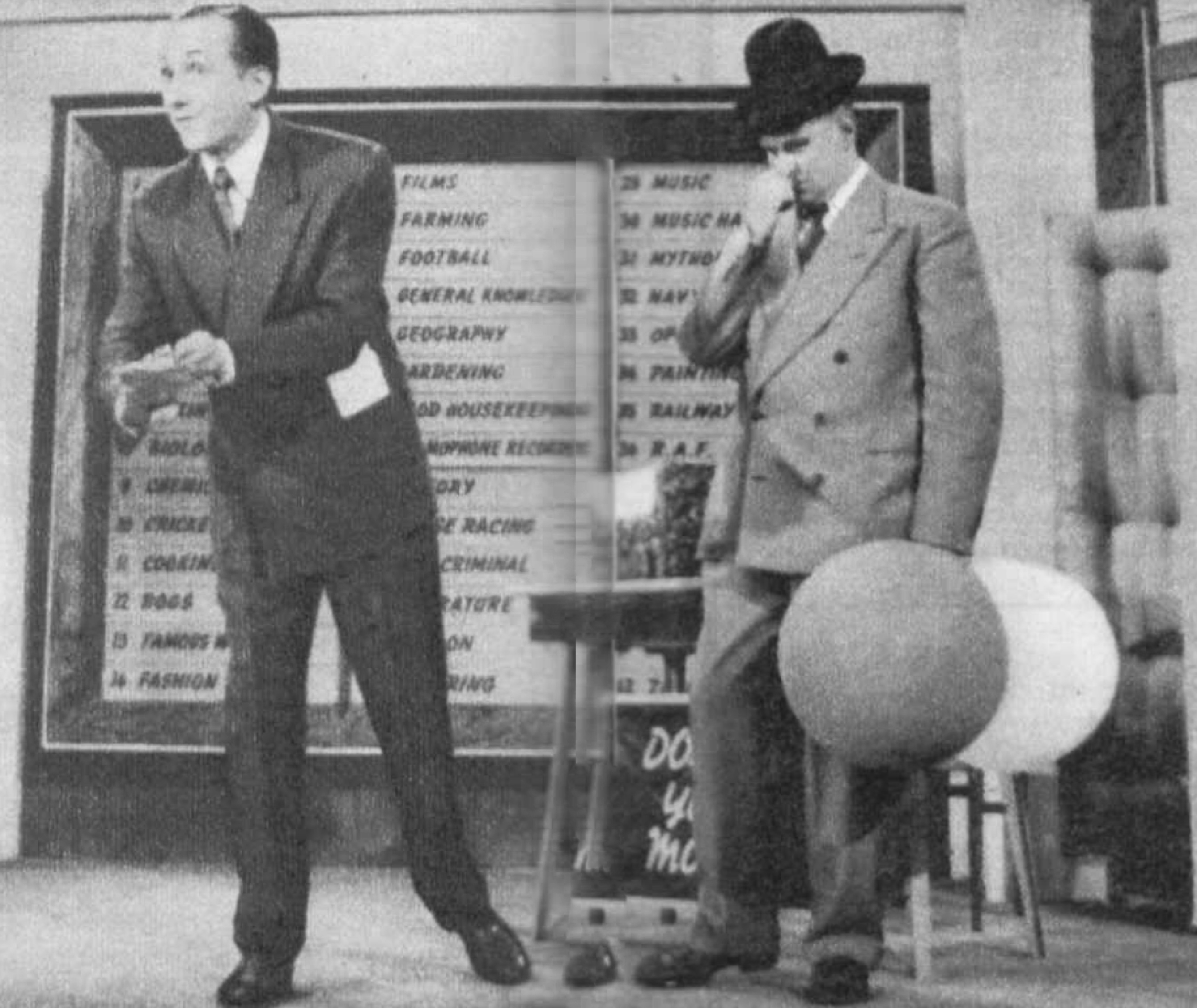
Ten years ago and Hughie Green and assistant Vic Hallam set the mood for Double Your Money in the warm-up before the show

It was the summer of 1955 and Hughie Green was telerecording the first of his famous Double Your Money quiz shows—one of the longest running shows on television.

The search for programmes by the new Independent Television companies was well under way four months before the service opened on September 22, 1955.

It was towards the end of May that an Associated-Rediffusion talent scout called at the Baker Street studios in London where Hughie Green was recording the radio version of his show for Radio Luxembourg.

“Would you like to try it for TV?” asked the talent scout.

“Would I?” said Hughie. “The answer’s ‘yes’.”

“I realised,” he says today, “what wonderful opportunities ITV was opening up for everybody in the entertainment and allied fields and I knew I’d have to be in it. We telerecorded a show and in less than a month Associated-Rediffusion had made up their minds to buy it.

“It was pretty tough doing them in those early days. Sometimes we were stuck for an audience. I remember one night only a handful of people turned up for some reason or other. So, even though we had makeup on our faces, all of us, including myself, went out into the streets and knocked on people’s doors and asked them if they would like to take part in a TV show. And that way we got a very good mob.

“Telerecording was fairly primitive in those days. The cameras could only shoot 10 minutes or so of the show at a time. You’d have got everybody warmed up and somebody would be about to say something funny, or somebody’s trousers would be about to fall off, when the cameraman would call out: ’The film’s run out.’

“So you’d swear at him, hate him and shout how you loathed the system and so on — and wait until he had re-loaded.”

Elsewhere, staff training was carried out at a furious pace.

Ex-BBC men like Stephen MacCormack and Barry Baker, men who had just started in television like ex-navy man Commander Robert Everett, were flown to New York to study how American commercial TV dealt with the tricky technical job of timing programmes and commercials.

At the small Viking Studios off Kensington High Street, two training courses with cameras and equipment were run for all the programme staff.

Directors, secretaries, sound mixers, vision mixers, lighting experts, cameramen — all listened to lectures and then tried out in practice what they had been taught. Alongside them, auditions for announcers, “personalities,” actors and actresses, were conducted on closed circuit television.

“I had to audition the announcers,” says Leslie Mitchell. “Anybody and everybody thought they could do it. Some were very nearly right: some were terrible. I think I must have auditioned about 300 people altogether — but it seemed like 3,000.”
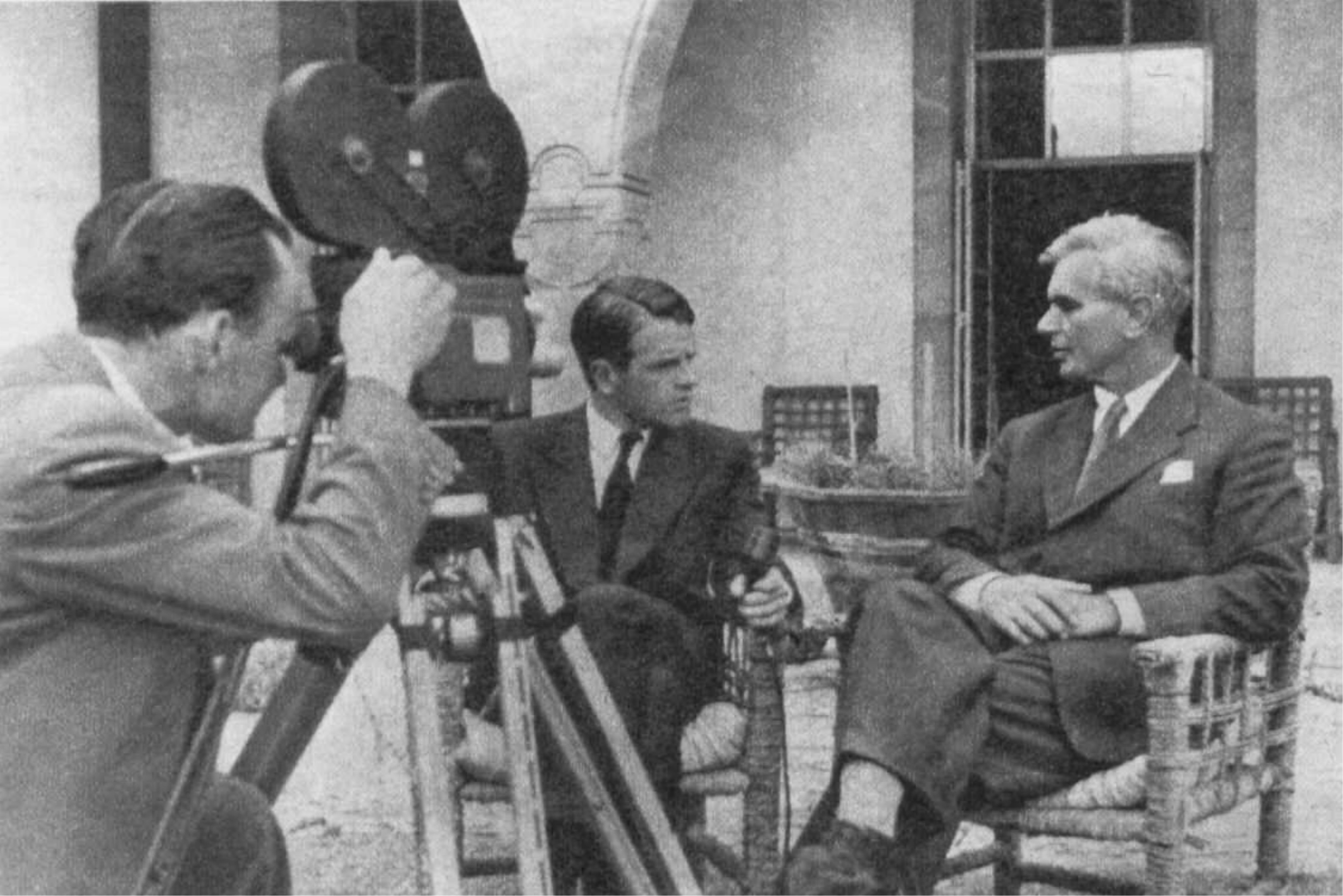
Chris Chataway interviewed the Deputy Governor of Cyprus, Mr. John Sinclair, in October 1955, as one of his first jobs for ITV

In ITN, Chris Chataway and Robin Day stumblingly learned to read news bulletins. “My most vivid memory,” says Chataway, “is of this wooden board which was put up to simulate a TV camera, into which we solemnly delivered these news bulletins. We would crane forward and talk into this wooden framework while everybody stood around and watched.

“Then we were taught how to conduct an interview. People forgot that the standard BBC interview in those days consisted of a reporter almost on his knees at the bottom of airport steps, saying: “How do you view the current situation, sir?” and taking the answer without once interrupting.

“I remember when the editor told me to interview Field Marshal Harding. ‘What will you say to him?’ he asked me.

“I thought I’d ask ‘how do you think things are developing in Cyprus, sir?’ ‘Whatever you ask him,’ said the editor, ‘don’t say: sir’.”

By this time Television House had become known affectionately as “The Hellpit.” Pneumatic drills chattered all day long. Carpenters and bricklayers worked alongside producers and directors. There were hazards and mysterious happenings.

“I had a desk at a window overlooking the well of Television House,” says drama director Cyril Coke. “One day I lifted my telephone to make a call. But the phone had gone dead. I rattled it once or twice but it stayed dead. So I crossed the office to another desk and began to dial from the extension there.

Suddenly, an enormous piece of steel girder came crashing down from the top of the building. It bounced off some projections, shot through the window on to the desk which I had just left.

“If I’d still been sitting there, almost certainly I’d have been killed. But the really extraordinary thing was when the phone people checked my extension, there was nothing wrong with it — it ought to have worked perfectly!”

The chaos and difficulties of working in Television House in those days is described by Eric Linden, features editor of TVTimes who remembers: “I used to go along there from the offices of TVTimes, then in Gough Square, to find out who people were and where they were. I remember checking with security man Glyn Davies to try to put names to people but he was just as baffled as anybody.

“It was quite easy in those days for anybody to walk in and out the place, in fact, one day he discovered two men occupying an office in Television House and using the phones to carry on a business. Neither had the slightest right to be there — they were just two strangers who had availed themselves of the conditions.”

The ITV Story

From the TVTimes for 16-22 October 1965

THERE was intense excitement in the newsroom of ITN. With the start of Independent Television only weeks away (Sept. 22, 1955), the tempo of training was becoming more and more frenzied.

For weeks the news staff, still without news sources of their own. had been cutting out items from the evening papers, pasting them on to bits of paper and passing them over to Chris Chataway and Robin Day so that they could practise reading “dummy” news bulletins.

But on this day the excitement was because a film of a prison break in America had just been flown in FROM New York. This meant that at last something not far removed from a real programme could be tried out.

Robin Day took his seat at a table, facing directly into a closed-circuit TV camera. To one side of him, an operator prepared to project the American newsreel on to the wall of the ITN newsroom. Hovering around, his spectacles pushed up on his forehead like a First World War pilot with raised goggles, was Aidan Crawley, then editor-in-chief.

Aiden Crawley… “Someone do a commentary”

Robin Day was cued-in by a producer. He read out two or three items, managing not to stumble at all, although he still couldn’t help plucking nervously at his bow-tie.

Then the producer bawled: “Cue telecine!” and with a whirring noise, the projector flashed the newsreel on to the wall. Robin said: “And from America, film of the prison riot!”

Suddenly little matchstick figures could be seen jumping back and forward on the walk But there was no sound!

For a moment the whole illusion of success was in danger as the film continued to flicker on in silence. In desperation Crawley’s voice rang through the newsroom: “For Pete’s sake, someone throw in a line of commentary! ”

Almost immediately the high, clear, normally cultured voice of girl announcer Lynne Reid Banks was heard rasping: “I’m Gonna break this goddam riot if it’s the last thing I do.” “Absolutely first class!” applauded Crawley. “That’s the stuff!”

Slowly but impressively ITV was gaining momentum; tackling and overcoming problem after problem; training its raw if enthusiastic staff, trying out its equipment — where it was fortunate enough to have any!

Commander Robert Everett, in charge of Outside Broadcasts for London’s Rediffusion, travelled up to Cambridge to collect an O.B. scanner which was at once christened “Sweetie Pye” by the staff. It was their first one and they were so pleased to get it. Then he told the Programme Controller: “Look, we’re going to take it over to the Festival Hall and try it out.”

The technicians lumbered off in a great big O.B. van, Everett himself following in his nippy sports car. A camera was set up by the side of the Thames while “Sweetie Pye” and a monitor screen, packed inside an O.B. van, were parked outside the Festival Hall.

Distance from camera to scanner was about 100 yards. Suddenly everything was switched on. The camera focused on a bus crossing Waterloo Bridge and as it did so, there was a yelp of excitement from Everett inside the O.B. van. “It works! ” he yelled, startling passers-by. “It works! We’ve got a picture!”

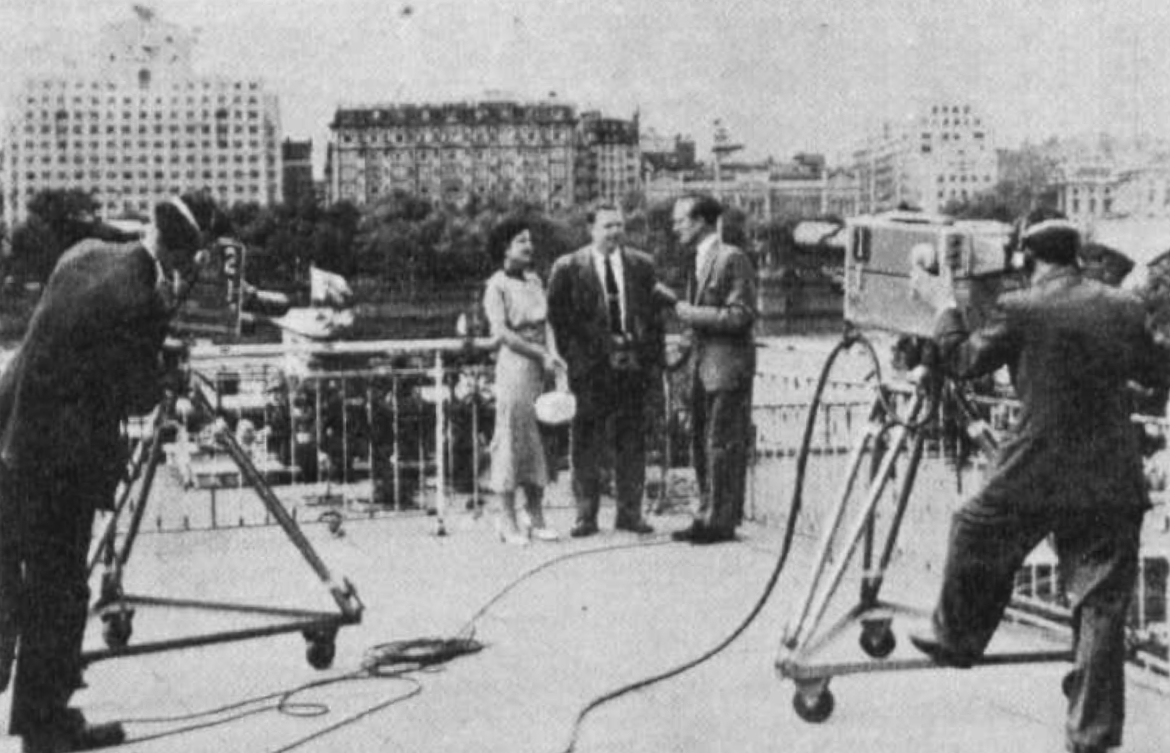
Cameras in position for the first Outside Broadcast trial

At once, he telephoned Television House to tell the waiting Programmes Controller the good news. Then, for half an hour or so, the whole unit enjoyed itself, taking pictures of passing buses or river craft, mocking up a commentary as they went along.

Yet enormous technical problems still remained to be overcome. At his office in Lower Regent Street, Commander E. N. Haines, in charge of technical installation for Rediffusion, scratched his head and wondered how to arrange a micro-wave link between the studios in Television House, Kingsway, the Granville Theatre and the various O.B. units operating in the held.

He desperately needed a pickup on a fairly high point at a place convenient to the centre of London. One day a letter from the Metropolitan Water Board landed on his desk. “Would you like to lease our Campden Hill water tower?” it asked. “We no longer need it.”

The water tower (which figures prominently in G. K. Chesterton’s novel, “The Napoleon of Notting Hill”) stands 156ft. high on top of a considerable rise of ground in Kensington.

Inside it was an enormous 10ft. pipe through which water used to be pumped to London. Could Haines get a micro-wave receiving dish up on to the top of it? Well, there was only one way to find out and that was to climb up and have a look.

It proved to be a fantastic job. Haines, a retired D-Day assault commander, accompanied by an official from the Water Board, a man in his 60’s, clung precariously to a small iron ladder running up inside the tower and climbed up the 156ft. to the top.

And three times they repeated this dizzy, frightening feat before they could be sure that the tower would prove perfect for the job.

Then engineers cut a big hole in the bottom of the tower, removed the water pipe, bit by bit, and built up a staircase inside. Just under the top of the tower, they erected a small room into which they packed all the reception gear for a micro-wave link.

Finally they hauled up a big dish and erected it on top of the tower so that it could be beamed all round London and could pick up O.B. units many miles away.

Although the men organising ITV were working 16 and 17 hours a day, they were getting a great deal of fun out of it all. One day Eric Linden, now Features Editor of TVTimes went along to an hotel to interview the American singer, Guy Mitchell, who was to star in the first of Val Parnell‘s Sunday Night at the London Palladium shows. When Mitchell had finished talking to reporters he asked Eric to stay behind for an extended chat.

Then to Eric’s surprise — and the horror of the waiters — he pulled a portable barbecue from his baggage and started grilling a couple of steaks in the middle of the room!